My Client Wants stained and or polished concrete. What is the difference?
We are asked this question on a regular basis. Although in the past we have always answered this question over the phone or at meetings, without the use of pictures, it’s hard to describe the “look” of a final floor and the process that gets you there.
The Purpose of this Post to help you understand the difference in Stained and Polished concrete and try to break the confusion of common questions and finishes involved when choosing an decorative concrete floor for interior purposes.
We will help you narrow down what your clients wants, needs, as well as how to ask the right questions to determine the correct solution.
I want Stained Concrete
The term “Stained Concrete” is one of the most common decorative concrete terms used to describe a decorative slab. Some of the floors I have seen over the years described as “Stained Concrete” Include floors that were actually: Concrete overlays, dyed floors, stamped concrete, polished concrete, and integral colored concrete. What makes each of these different is the “kind” of stain used the process to complete the floor, and the vast options of sealers to protect the final product if in fact a sealer is needed.
Items listed above that we will not talk about
– Concrete Overlays: Concrete overlays are a cementitious material that is applied over an existing concrete surface to repair or beautify it. It can also be used to create a clean canvass for staining.
– Stamped concrete: Stamped concrete is a process done while the concrete is being put in place. Have the concrete has been laid and is still wet, a variety of mats may used to create a number of different patterns into the surface.
– Integral Concrete: This means the concrete has been colored in the cement truck prior to placement. Concrete that has integral color may be stained, sealed, but is a good option for someone pouring a new concrete floor they plan to polish and want a color in the floor.
It’s best to first understand that concrete stains fall into one of the two categories. I will not go into great detail as to how each work, as there are plenty over resources that have covered the topic.
– Reactive: This stain has a chemical reaction to the free lime in the concrete leaving a permanent color change. Acid stains would be considered a reactive stain, although there are other water based stains that are reactive.
– Non-Reactive: These stains can be comprised of a product with a very small particle size that absorbs into the pours of the concrete creating a permanent color change. There are also topical acrylic stains that would fall into this category, but they are more of a topical stain.
Lets take a look at a couple different types of Stains and Process to achieve them.
Concrete Acid Stain (Reactive)
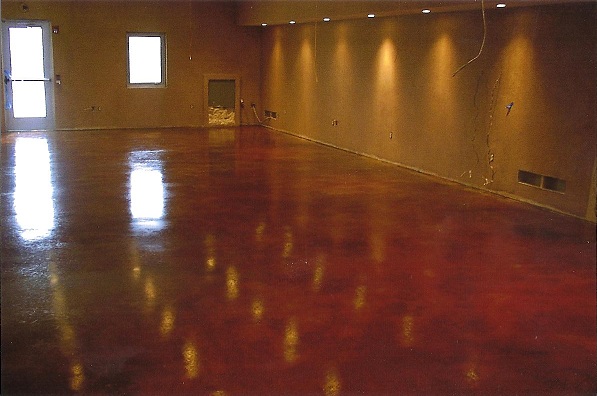
This picture is of a concrete acid stain on a new concrete floor. As you can see there are a variety of colors in the floor. With this being a new slab, the acid stain came out more uniform than what it would have on a older floor. That is becasue an older floor would have more characters to it. Cracks in an older floor tend to stand out more, along with other imperfections. Such as chemical spills, adhesive, and diffrent things that would change the reaction process. On this particular floor if more colors or character would have been wanted, using another stain along side “main” stain would have achieved that. There are also other products that can be used alongside acid stain and techniques to create different effects. With acid stains you have less control over the outcome. If the floor had been contaminated in the past by another product or chemical, it will show through the floor. Sometimes this can be very neat, and other times unfortunate.
To prepare this floor for the concrete staining:
the floor was cleaned several times
Walls taped for protection
Acid Stain Applied
Residue Removed
solvent based sealer Applied.
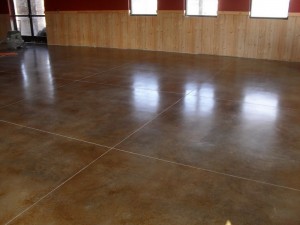
This picture is another type of Reactive Concrete Stain called color juice and it’s water based. To acheive this a plantery grinder was taken over the floor several times with different diamond pads.
The Process:
Clean floor
Start grinding steps 1-4
apply stain.
Clean
Apply water based color guard (Sealer)
Acrylic Stains
The picture above is a Acrylic Concrete stain. These are a more topical type of stain that has a more opaque effect to the concrete and more consistant color. You can acheive an acid stain type look through different application techniques, but require more of an artist to do so, as the material doesn’t react with the concrete. Although it is more durable than paint, I do not recomend this method of staining, special for high traffic floors. These products are normally sold at national chains and box stores becasue they are easy to apply. The life of the floor is limited, and often not the staining effect the customer or client had in mind.
Dye and Seal
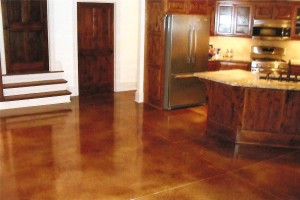
Dye and Seals are a non reactive concrete dye that’s poweder content can be mix with a number of solvents or even water to make the stain. Using different solvents effects the outcome and changes the dry time of the dye. As you will notice in this picture, dye and seals have multiple colors, but they are of the same “color Family”. Basically a variety of shades of the same color and the outcome depends on how the material was applied.
Clean floor
Apply Dye
Clean Residue
Seal
So now you have been given a summary about the different types of stains and a few pictures to illustrate them. I could have choose floors for each product that made there look to be a dramatic differance, but I didn’t want to use exaggerated photos. Your question might be now, which one is best? All of these products have their place in the market, it really depends on the floor. For instance, a floor that has had multiple adhesive on it that had to be removed, probably isn’t the best for an acid stain. The outcome of that floor would be wide open with only a guess at the outcome. And I should point out, that not every floor is a candaite for a concrete stain.
Contraversally, a brand new concrete floor might not be right for an acid stain. Because it is new you won’t get all the character an old floor would naturally get. You very well might be able to achieve the same look with an equally durable product without as much labor.
You can’t talk Concrete Stains without talking about Sealers.
Every concrete stain needs a sealer, this helps protect the concrete from other staining, protects the color in the floor, and deepens the color and effect of the concrete stain. You want a durable sealer, and need to decided on a gloss level. Here is a real basic guide to sealer durabilty.
Water based: Has different gloss levels, generally will not get the shine of a solvent based product.
Solvent based: More durable, strong fumes, generally creates the most gloss.
Basic order of durablitly from least to greatest protection
– Water based single component (depends on type, no gloss to statin gloss)
– Solvent based single component (decent gloss to high)
– Water based two component (Your choice of gloss level)
-solvent based two component (your choice of gloss level)
-water based epoxy base with water based urethane topcoat (Your choice of gloss level)
-solvent based epoxy with solvent based urethane topcoat (Your choice of gloss level))
-100% solids epoxy with urethane topcoat (High Gloss)
-Polyaspartic polyurea (Your choice of gloss level)
I hope this list of sealers at least gives you an idea of all the different types, and that their are many choices. Your contractor should identify which is best for you floor.
Polished Concrete
As with stained concrete, polished concrete comes with options and different floors require a different approach. Here I will show you the basic process of polishing concrete, and some of those different options.
What do you ask you client to determine what kind of floor they really Want when they say they want a polished/stained floor?
1. Do you want a high gloss floor, Satin, or flat finish?
2. Do you want a floor with a lot of character, or do you want more of a tinted color throughout the floor that’s more consistant?
3. What type of use will this area or building be used for?
4. New concrete or old concrete?